
Article published in The Daily Telegraph, 24 January 2026. © Richard Kemp
Of course those of us who served alongside the Americans in Afghanistan are going to get defensive when hearing President Trump’s harsh accusations against our forces and those of our other Nato allies. And there has already been a torrent of outrage. But more instructive are American reactions to his suggestion that European forces in Afghanistan ‘stayed a little back, a little off the front lines’.
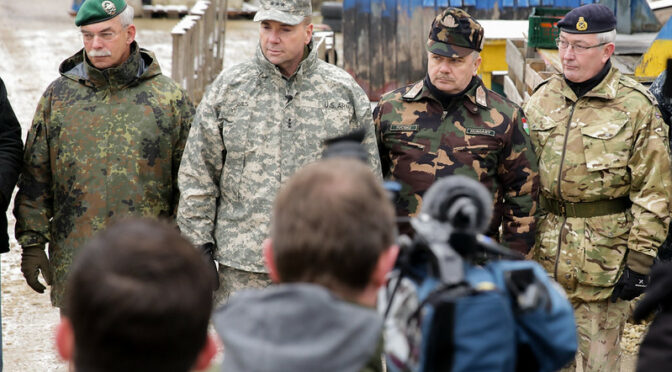
For example General Ben Hodges, who was commander of the US Army in Europe, said: ‘This is about as angry as I’ve been for quite some time. … There’s no American soldier that believes what our president just said’.
Trump’s views are contradicted also by what other senior Americans have said before. At the height of the Afghanistan war, General James Mattis, who commanded US forces in Afghanistan and later served as defence secretary in Trump’s first term, said of the British: ‘I can assure you that it is a delight, if we must go into a brawl, to do so alongside your competent, valiant troops.’ And last year the vice-president, JD Vance, who served with the US Marine Corps in Iraq, said that British forces ‘have fought bravely alongside the US for decades’.
Actually it’s rather more than decades. The first time British and American troops were in action together was in 1859 in China when the US Navy came to the assistance of British forces, breaching American neutrality in the Second Opium War. Our unbreakable military partnership – the backbone of the special relationship – continued through the First and Second World Wars, in Korea, the Balkans, Afghanistan and Iraq. In fact the only major American conflict we did not join was the Vietnam War.
Pondering whether other Nato countries would step up to the plate if required, Trump said: ‘We’ve never needed them.’ That, too, is far from reality. US General David Petraeus, who commanded American and coalition troops in Afghanistan and Iraq, was quite clear: ‘As was the case in Iraq, the scale of the British contribution in Afghanistan is such that the coalition cannot succeed without you.’
Some might think that these American generals were being polite about their British allies. I know differently. Having served alongside the US in Afghanistan, Iraq and the Balkans, it was obvious how much they genuinely valued and respected their cousins, as we did them. My experience echoes that of Mattis: ‘British and American troops blend together on the battlefield with unspoken ease and trust.’
Of course they sometimes criticised us, as we did them, and as true friends should. Their harshest condemnation, often repeated in recent years, has been the extent to which British forces have been hollowed out, reducing battlefield utility. That strongly held concern about our military capability itself underlines the value that American commanders place on having the British in the fight.
This same disquiet extends across all of Europe and of course lies behind Trump’s intemperate and deeply unfair remarks. He, as well as other US presidents, have long considered that Europeans have been freeloading on America rather than investing in their own defences – and not without reason.
Trump’s frustration has been intensified recently by European resistance to his designs on Greenland, not least the performative deployment of a handful of European troops for an ‘exercise’ in the country.
Whatever the rights or wrongs of Trump’s aspirations there, the more intelligent approach was that of Nato secretary-general Mark Rutte, who managed to come up with a formula to save face on both sides.
It seems Trump has also been angered by Sir Keir Starmer’s plan to surrender sovereignty over the British-American base at Diego Garcia in the Chagos archipelago to Mauritius, a Chinese ally. He’s right to be concerned about that. It’s a strategically vital base for both Britain and America, and right now it is playing a crucial role in building up US forces ranged against the ayatollahs in Tehran.
Notwithstanding the apparent British weakness over Diego Garcia, if the Iran conflagration is reignited, as looks likely, the British will again be there alongside the Americans.
While significant US air and naval assets arrive in the Middle East, the RAF has just deployed Typhoon combat planes to the main US base in Qatar, no doubt at American request. British pilots will be in the front line, endangering their own lives. They will not be ‘staying a little back’.
Image: Lt Gen Ben Hodges (second left), with (left to right) German Army Deputy Commander of Land Force Command Lt Gen Jörg Vollmer, Hungarian Defense Forces Commander of Joint Forces Maj Gen Sandor Fucsku, and British Army Assistant Chief of General Staff Maj Gen David Cullen. Source: 7th Army Training Command/Flickr