
Article published in The Daily Telegraph, 11 February 2026. © Richard Kemp
America is going into ‘burst mode’, seriously ramping up production of vital missile stocks. Recent commercial framework agreements with the Department of War for ground attack systems and interceptors aim to increase output up to four times current rates to meet global demand unprecedented since 1945.
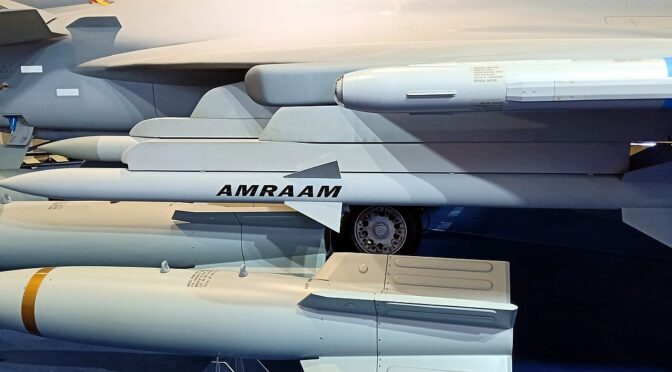
According to a recent contract announcement, the US will raise production of the well-known, very powerful Tomahawk cruise missile to ‘more than 1,000’ per year. Output of the Amraam beyond-visual-range weapon, America’s premier air-to-air missile at the moment, will rise to ‘at least 1,900’ annually. Manufacture of the SM-6, one of the few defensive weapons able to shoot down hypersonic threats, will rise to ‘more than 500’ annually. Production of the complex SM-3, able to engage ballistic missiles or even satellites flying outside the atmosphere, will also rise.
Meanwhile Britain is taking its customary plodding approach to the same problem. Knowledgeable observers have suggested that our munitions stocks – from rifle bullets and artillery shells to long range missiles and drones – would see out only about a week of intensive fighting. That’s even taking account of the fact that our Armed Forces are now very small, having been repeatedly hollowed out by successive governments. Even the handful of soldiers and tanks we could put into the field would be out of ammo in a matter of days.
We haven’t been firing a lot ourselves in recent years, but we have given much of the little we had to Ukraine, with the cupboards now worryingly bare.
How did we get into this parlous condition in the first place? The answer is that after the Cold War ended, Britain – like the rest of Western Europe – did not expect any more large-scale state-on-state wars. Our generals planned only for short-term limited overseas conflicts. Our Armed Forces were sized and stocked for counter terrorism, Afghanistan and Iraq style conflicts and limited precision strikes. That meant lean stockpiles rather than warehouses full of shells and missiles.
To save money we also shifted to just-in-time manufacturing which is efficient for commercial businesses but disastrous when an unexpected war might be just round the corner. Of course it was the generals who planned all this but we shouldn’t forget how tightly they were controlled by political leaders who repeatedly savaged defence budgets so they could spend eye-watering sums on welfare.
The war round the corner this time was Russia’s all-out offensive on Ukraine which has seen thousands of artillery shells fired every single day, and missiles fired in huge numbers by the Russians: the Ukrainians, having fewer sophisticated weapons, have had to be more sparing.
When America needs more bombs and bullets it surges production, the ‘burst mode’ I mentioned, to create a great leap forward. In Britain, and the rest of Europe, we don’t do that, we just clump along with some minor fiddling at the edges, always evolutionary, never revolutionary.
For example, during the Iraq and Afghanistan campaigns when British soldiers were dying in poorly protected Snatch vehicles, their up-armoured replacements were manufactured with all the urgency of a family saloon. No 24/7 production, no new factories opened, no new money. Just business as usual which cost lives and reduced combat effectiveness. At last we are building at least six new ammunition and explosives factories, but it is still not sufficient and the end result is likely to be that even restoring our inadequate pre-Ukraine stocks will be a five to 10 year process. Let’s hope neither Vladimir Putin nor Xi Jinping get too frisky between now and then.
Meanwhile, across the Atlantic, the alien ‘burst mode’ involves the US government underwriting risk to manufacturers, paying up-front for factory expansion and guaranteeing purchases if the war cools down. Shifts are increased and factories run round the clock. When necessary older, proven designs are implemented with lower specs if that speeds up output. Regulation can be relaxed, priority access is given for raw materials and if there’s waste there’s waste. The brass hats in the British procurement system and the mandarins at the Treasury would throw up their hands in horror at most of that; it reduces financial efficiency and costs a great deal of money.
Dramatically upping production of more technically sophisticated gear such as drones, precision missiles and air defence systems is much more difficult than churning out dumb bombs, and we would have to lean on suppliers in the US and perhaps Israel. Here, the Labour Government seems to be trying to throw another spanner into the works with efforts to join Safe, an EU defence fund that Sir Keir Starmer again raised on his recent trip to China. That would force British firms to acquire key technology and parts from Europe. You can imagine the effects of re-applying the dead hand of EU bureaucracy and supervision, as well as excluding procurement from the US, with our defences already in such dire straits.
In an increasingly dangerous and unpredictable world, it is essential that Britain is able to deter potential enemies. That can only be done through hard defences. Rebuilding munitions stocks to make our Armed Forces credible again is an essential part of that but requires a lot of money to be thrown at it right away, not in a couple of years. This divided and now weakened Government shows no inclination to do anything like that.
We may live to regret it.
Image: Wikimedia Commons
