
Article published in The Daily Telegraph, 9 June 2026. © Richard Kemp
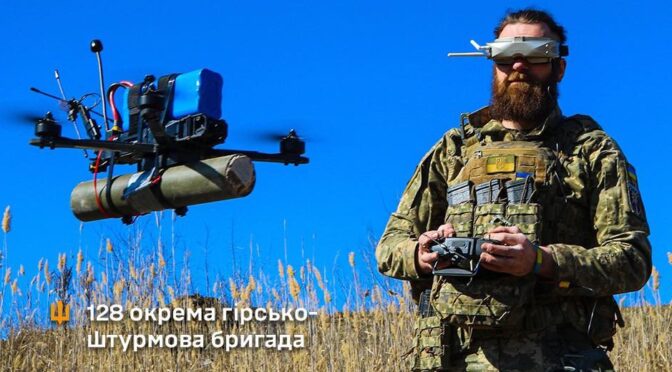
I recently visited Ukraine’s 3rd Assault Corps, perhaps the world’s leading military force in the realm of remote-controlled warfare. I witnessed its surveillance and attack drones in action and under construction plus the training of drone pilots. Another system pioneered by the Corps is unmanned ground vehicles, which are utilised extensively for assault operations as well as fuel, water and ammunition supply and casualty evacuation.
The scope, scale and sheer innovation of what I saw could only be witnessed in a nation at war, fighting for its survival and desperate to conserve the lives of its soldiers in an unequal fight. Lacking the perfection demanded by our Ministry of Defence, much of 3rd Corps’s equipment would never get anywhere near the end of the tortuous British procurement process. But the unmanned systems I saw actually worked. They are constantly modified as combat lessons are learnt, and are playing a major part in holding the Russians back.
That much can be seen by Putin’s increasingly precarious situation in Crimea, Kherson and the Donbas. Here, Kyiv’s strategy has been largely focused on Russian logistics. No modern army can function without reliable supply chains that allow delivery of fuel, ammunition, weapons, water, rations and also enable repair and replacement of knocked-out vehicles and armaments.
Targets for attack include not only the commodities themselves but also supply routes including roads, railways and waterways. Compared to other high-priority targets like command posts and air defence systems, logistic chains are far harder to protect as they are spread over vast distances, inevitably using predictable routes, often without many alternatives.
Occupied Crimea in particular is coming under great pressure at the moment. Repeated Ukrainian attacks on the Kerch Bridge by missile, truck bomb and sea drone have resulted in the Russian army banning its use for fuel tankers and other large vehicles. That has forced them to re-supply forces there and in the Kherson district, as well as the civilian populations, overland from Rostov oblast and through occupied Donbas. This is the so-called ‘land bridge’ along the Azov coast.
Those routes though have now become increasingly dangerous courtesy of large numbers of Ukrainian mid-range attack drones which prowl and strike military convoys almost at will. Each is capable of delivering an explosive load of up to 150kg over a range of up to 100 miles. Ukraine has surged its domestic production of these drones in recent months, shedding the constraints of foreign-manufactured systems or parts.
These weapons have also severely impacted the Russian front-lines in Donbas itself where Putin’s forces have had their already plodding advances further slowed by drone attacks on both fighting troops and the supplies they need to push forward. According to some reports, Russia has lost more territory to Ukraine than it has gained in the last two months of its faltering summer offensive.
Longer-range drones have also inflicted significant damage on logistics facilities deep inside Russia. A few days ago, when Ukrainian drone swarms attacked St Petersburg during the annual economic forum hosted by Putin, they also hit a munitions dump and an oil depot in Krasnodar region some 300 miles away. Since last year, Kyiv has conducted drone strikes against multiple Russian oil refineries, including as far east as Siberia, not only disrupting military fuel supplies but also leading to long lines at the petrol station in some regions.
The advantage that Ukraine currently has in drone warfare, largely as a result of its own efforts, may not last long as Russia develops its inevitable countermeasures. Such ups and downs are always present in warfare, as Ukraine itself has shown with its defences against Russian drones and ballistic missiles. The Ukrainian military depend heavily on foreign-supplied air defence missiles such as the US Patriot and Franco-Italian SAMP/T plus anti-aircraft guns, particularly the German Gepard.
Less known are their remarkable electronic warfare (EW) capabilities. While in Ukraine a couple of weeks ago I visited a factory manufacturing the Lima EW system. In the short period it has been in service, Lima has taken down thousands of Russian drones, thousands of precision-guided aerial bombs and hundreds of ballistic and cruise missiles by spoofing their guidance systems: all at a fraction of the cost of kinetic interceptors. It was invented and constructed in Ukraine and is another testimony to the innovation of a country at war.
Britain is always eager to boast of our assistance to Kyiv. Now though is the time for us to learn from Ukraine’s painful experiences over the last four years of all-out war with Russia. That applies in many areas including our sclerotic procurement system. But nowhere more than in the offensive use of aerial drones and unmanned ground and sea vehicles as well as defences against the very air threats that our own forces, and perhaps our civilian population, are likely to face in the future.
Image: ArmyInform, Ukraine